If you’ve ever owned a car that’s spent a few years cruising city streets, country backroads, or parking lots under the sun, you’ve probably noticed that hazy, yellowed film creeping over your headlights. That’s headlight hazing, and it’s one of the most frustrating, misunderstood issues for car owners and detailers alike. For years, many have turned to products like PPF (Paint Protection Film) headlight tint as a quick fix, and our team at [supplier name] gets questions about this every single day: Will PPF headlight tint hide hazing on headlights, or is it just a temporary band-aid that causes more problems down the line? PPF Headlight Tint
Let’s start with what headlight hazing actually is, because you can’t answer the question without understanding the science behind it. Most modern car headlights are made of polycarbonate plastic—lighter and more shatter-resistant than glass, which is why auto manufacturers switched to polycarbonate decades ago. But polycarbonate is porous and inherently sensitive to UV rays, oxidation, and road grime. Over time, UV radiation breaks down the polymer bonds in the plastic, causing it to micro-crack beneath the surface. That micro-cracking is what looks like haze, yellowing, or fogginess to the naked eye. It’s not a stain on the surface; it’s structural damage to the headlight itself. A lot of people think polishing will fix it, and it can—for a while. But polishing removes a thin layer of plastic, and if the haze is deep, you can only polish so much before you risk cutting through the headlight’s structural integrity entirely.
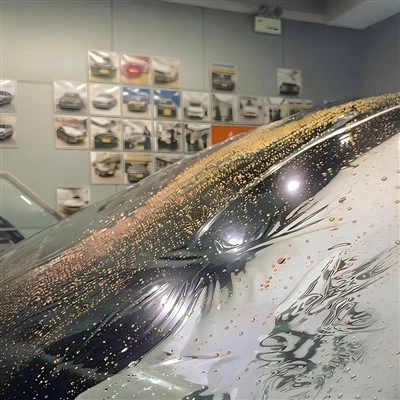
Now, what is PPF headlight tint, and how does it work? PPF, or Paint Protection Film, is a thermoplastic urethane film engineered to protect surfaces from scratches, rock chips, UV damage, and oxidation. When it’s applied to headlights, it’s not just a decorative tint (though some options are tinted for style); it’s designed to act as a new, protective layer over the headlight. That’s a key point: high-quality PPF headlight tint is a clear or colored film that bonds tightly to the headlight’s surface, creating a barrier between the damaged polycarbonate and the environment.
So, does that mean PPF headlight tint hides hazing? The short answer is: it can, but only if the hazing is not too deep, and only if the film is installed correctly. Let’s break that down. If your headlight’s haze is surface-level—like light oxidation or a thin layer of road grime that’s discoloring the top layer of plastic—PPF’s smooth, optically clear (or tinted) surface will cover that. The film’s clarity and even texture obscure the micro-cracks beneath, so the naked eye only sees the smooth, uniform film. In that case, it looks like the haze is gone, even though the underlying plastic is still damaged. That’s why some people call it a “hide” rather than a “fix.”
But here’s the thing most suppliers and installers won’t tell you: if the hazing is deep—meaning the micro-cracks are so widespread they’re visible even at 360 degrees with a light—PPF headlight tint can’t fully hide it. The film is transparent enough that those deep micro-cracks will show through, creating a foggier, less polished look than you’d get from a properly polished, then clear-braced headlight. That’s not a failure of the PPF; it’s a limitation of the material. Even the best optical-grade PPF can’t cover up deep structural damage to the polycarbonate beneath.
Now, let’s talk about the flip side of that: what happens if you try to use PPF headlight tint to hide hazing that’s too deep, without prepping correctly. That’s where a lot of mistakes happen, and where many of our customers come to us with headaches. If you install PPF over a hazy headlight without polishing it first, you’re trapping that moisture, oxidation, and micro-crack residue between the film and the plastic. Over time, that trapped gunk will break down, causing the film to bubble, peel, or even turn yellow itself. Worse, some installers use a cheap, adhesive-heavy PPF that doesn’t breathe—so moisture gets trapped between the film and the headlight, leading to mold or mildew growth, which eats away at the polycarbonate from the inside out. That can turn a minor hazing issue into a full headlight replacement cost, which is way more expensive than polishing and a proper PPF application.
Another common myth: any PPF headlight tint works for hiding haze. That’s not true. There’s a huge difference between a $5 roll of generic PPF and the urethane-based PPF we supply at our company. Generic films are thin, have poor optical clarity, and their adhesive doesn’t bond evenly. If you use a cheap film over a hazy headlight, the haze will show through within weeks, and the film might start to peel at the edges in just a few months. Our PPF headlight tint is engineered for headlight use specifically: it has a 99.9% UV-blocking layer that prevents the polycarbonate from degrading further, a self-healing coating that seals minor surface micro-cracks, and optical clarity that’s designed to obscure minor hazing without distorting light output. That last part is critical: if you’re using a tinted PPF, make sure it’s engineered for headlights, not just body panels. A dark tint might hide hazing, but it can also reduce light output to levels that are illegal in most states, and dangerous for night driving.
We’ve seen this scenario play out hundreds of times. A customer brings in a 3-year-old SUV with hazy headlights, thinking PPF will make them look new again. The installers slap a generic clear film on top, and three months later, the customer is back saying the haze is darker and the film is peeling. When we inspect it, the micro-cracks were deep, the cheap film didn’t block UV, and the trapped oxidation between the film and headlight made the damage worse. We recommend polishing the headlights first to remove as much surface haze as possible, then applying our premium PPF headlight tint to seal the remaining minor micro-cracks. That combination hides the haze, protects the headlights from further damage, and lasts up to 10 years if maintained properly.
Wait, so is there ever a time when PPF headlight tint is the right choice for hiding haze? Absolutely. If your headlights are mostly clear with just a light, subtle haze—like what happens after a year or two of driving—PPF is a great option. It’s faster than a full professional polish and clear coating, it doesn’t require sanding the headlight (which some detailers argue can weaken the plastic), and it doesn’t yellow or peel like cheap clear coat over time. Our customers who have mild haze love it because the film makes their headlights look like new, and it prevents the haze from coming back for a decade.
But if you’re dealing with heavy, deep hazing—where the headlight looks yellow and foggy even when held up to a bright light—PPF headlight tint alone won’t hide it. You’ll need to polish the headlight to remove the surface micro-cracks first, then apply PPF to seal the plastic. Skipping the polishing step is a waste of money, and it will lead to frustration down the line. That’s why we always tell our customers to assess their headlight haze before ordering PPF: a quick test is to clean the headlight with a degreaser, then hold a flashlight against the back of the headlight. If you can see light through clearly, the hazing is surface-level, and PPF will hide it. If the light is diffused and foggy, you need to polish first.
Now, let’s talk about the long-term pros and cons, because hiding haze isn’t just about looks—it’s about functionality. Headlight haze reduces light output by up to 70% in some cases, according to a 2022 study from the Society of Automotive Engineers (SAE). That means hazy headlights are dangerous for night driving, and can cause eye strain during long trips. PPF headlight tint, when applied correctly and after polishing, not only hides the remaining haze but also preserves the headlight’s light output. The smooth, clear surface of the PPF doesn’t scatter light like the micro-cracks in a hazy headlight do, so your headlights will be brighter and safer.
On the con side: if you use PPF to hide haze without prepping, you’re locking in damage. The micro-cracks in the polycarbonate will continue to expand under the film, because UV radiation can still penetrate many cheap PPF films. That leads to deeper hazing, and eventually, the headlight will need to be replaced. Also, if you ever want to remove the PPF later, the adhesive can leave residue on the headlight, and if the haze was trapped under the film, you might have to polish again after removal to restore clarity.
At our company, we supply PPF headlight tint to detailers, body shops, and car enthusiasts across the country, and we’ve built our business on educating people about what our product can—and can’t—do. We don’t sell our film as a magic fix for deep hazing, because we know that’s not true. But we do know that for millions of car owners with mild haze, our premium PPF headlight tint is the best way to hide the damage, protect their headlights, and keep their driving safe.
A common question we get from new customers: Can PPF headlight tint hide haze better than a clear coat? The answer is, for long-term hiding, yes. Clear coat is a liquid that dries on the surface, but it can peel, yellow, or chip within 2-3 years, and it doesn’t seal out UV as well as urethane-based PPF. That means the haze will come back faster, and it won’t look as smooth. PPF, on the other hand, is a flexible, durable film that can last up to a decade, so the haze stays hidden for much longer.
We also want to address a misconception that some people have: that PPF headlight tint is only for show cars. That’s not true. Our film is used by commuters, family car owners, and truck drivers who drive hundreds of miles a day, because it protects their headlights from rock chips, salt, and sun, and keeps them looking new. For these drivers, hiding mild haze is a side benefit, but the main benefit is long-term protection.
So, to circle back to the original question: Will PPF headlight tint hide hazing on headlights? The answer is, it depends. If your hazing is surface-level, you prep the headlight properly, and you use a high-quality PPF engineered for automotive headlights, yes—it will hide the haze. If your hazing is deep, or you skip the prep step, it won’t hide the haze, and it might make the problem worse. The key is to be honest with yourself about the condition of your headlights, and to choose a product that’s designed to work with your specific needs.
For anyone looking to address headlight haze, whether you’re a car owner wanting to fix your own headlights or a detailer expanding your service offerings, it’s important to work with a supplier that provides accurate, science-backed information. At our company, we don’t overpromise what our PPF headlight tint can do, because we know that transparency is the best way to build trust with our customers. We believe that hiding haze should be a safe, effective way to care for your car, not a quick fix that leads to more problems.
If you’re ready to source high-quality PPF headlight tint, or if you have questions about applying it to hide hazing on your own headlights, reach out to our team to discuss your specific needs. We’re here to provide guidance, product samples, and support to help you get the best results, whether you’re a small detail shop or a large auto body operation. The right PPF headlight tint, paired with proper installation, will not only hide minor hazing but also protect your headlights for years to come.
Glass Security Film References
- Society of Automotive Engineers. (2022). Effects of Polycarbonate Headlight Degradation on Nighttime Driving Visibility. SAE International Journal of Passenger Cars – Mechanical Systems.
- Automotive Coatings Association. (2021). Polycarbonate Surface Degradation and Protection for Automotive Headlights. Annual Technical Report.
- International Organization for Standardization. (2019). Standard Practice for Testing UV Resistance of Automotive Polycarbonate Plastics. ISO 4892-3:2019.
- Professional Detailers Association. (2020). Headlight Haze Prevention: Best Practices for PPF Applications. Detailer’s Guide to Surface Protection.
Shaoxing Zirui New Material Technology Co., Ltd.
We are one of the most professional ppf headlight tint manufacturers and suppliers in China, also support customized service. We warmly welcome you to wholesale cheap ppf headlight tint for sale here and get quotation from our factory. For price consultation, contact us.
Address: Building 23, Phase II, Huanpu International Industrial Park, No.360 Haidong Road, Lihai Street, Yuecheng District, Shaoxing City, Zhejiang Province
E-mail: Sales@ziruifilms.com
WebSite: https://www.ziruifilms.com/
