Hey there, ever grabbed that tiny bottle of eye drops, essential oil, or maybe that little serum you keep by your desk and thought, “How the heck does that dropper cap fit so perfectly—no leaks, no dribbles, just exactly the drop you need?” If you’re a packaging nerd, a supplier, or just someone who’s ever stared at a cap and wondered about the process behind it, you’ve come to the right spot. I run a cap mold company, and let me tell you, dropper cap molds are the unsung heroes of tiny, precise packaging that almost nobody talks about. Cap Mold

First off, let’s cut through the jargon. A dropper cap mold is basically a custom-designed tool (think of it like a super detailed cookie cutter, but way more intense) that manufactures the plastic dropper caps you see on all those small liquid bottles. Wait, not just any caps—these aren’t the screw tops on a soda bottle. Dropper caps have two key parts that make ’em special: the rubber or silicone teat that squeezes to pull liquid up and release drops, and the plastic ring that screws onto the bottle neck, holding the whole thing in place. The mold has to make both parts, or sometimes work in tandem with inserts, so every cap is identical, no sharp edges, no leaks, and just the right amount of give in that teat. Like, if a dropper cap’s teat is too stiff, you can’t get a drop out; too soft, it’ll crumble after a few uses. The mold is where that exact balance gets nailed.
Let’s break down how these things work, because it’s way more technical than you’d think. I’m not gonna bore you with 10-page engineering blueprints, but here’s the gist. Most dropper caps are made from plastic—usually PP (polypropylene) or sometimes PE (polyethylene) because both are flexible enough for the teat and tough enough for the ring. The mold itself is a block of hardened steel or aluminum machined with super precise cavities. For a basic dropper cap, you’ve got two main cavity sets: one for the outer screw ring, and a smaller, shaped cavity for the teat. Wait, but how do you get that tiny teat out of the mold without breaking it? Oh right, we use ejector pins—little spring-loaded rods that push the finished part out once the plastic cools. But with dropper caps, sometimes we also use collapsible cores for parts that have undercuts, like the little notch that keeps the cap from twisting too far when you screw it on. If that core doesn’t collapse just right, you’ll bend or break the teat when ejecting. I’ve had reps come to me with 500 bad caps because their old mold’s ejector system was garbage—they didn’t have to make parts that perfect, but now every brand’s expecting that.
Wait, let’s talk about why these molds matter so much, especially right now. The small liquid space is blowing up—think CBD tinctures, pet eye drops, facial serums, even those little travel-sized medication bottles. Every single one of those needs a dropper cap that works every single time. If a cap leaks in transit, that whole shipment is ruined. If the teat gets gunked up after three uses, customers return the product. I had a client a few months back who got a bad batch of dropper caps from another supplier—their 10,000 units all leaked during shipping to a beauty brand, so they lost $40k and a big client. That’s the kind of thing a good dropper cap mold prevents. The mold isn’t just making a part—it’s making a part that keeps a brand’s reputation intact.
Now, you might be wondering, “Can’t you just use any old injection mold for dropper caps?” Nah, man—dropper cap molds have specific features that regular caps don’t. First, tolerance. We’re talking thousandths of an inch here. The screw threads on the cap have to line up exactly with the bottle neck, otherwise it’ll cross-thread and strip. If the teat’s inner diameter is even a little off, it won’t seal tight against the glass or plastic tube inside the bottle, leading to leaks. Most standard cap molds have tolerances around 0.005 inches; dropper cap molds? We hold it to 0.002 inches. That’s like the thickness of a human hair, for reference. Second, the gate location. The gate is where the molten plastic gets injected into the mold cavity. For regular caps, you can hide the gate on the bottom or side, but for dropper caps, the gate is almost always tiny and on the inner part of the teat so it doesn’t leave a visible mark on the outside. No brand wants a cap with a big plastic nub on the side that looks cheap. Third, we have to account for shrinkage. Plastic shrinks as it cools, right? So when we design the mold cavity, we have to make it slightly bigger than the final part, because once the plastic cools down to room temp, it’ll shrink by a predictable amount. For PP, that’s about 1.5% shrinkage, PE is around 2%—but dropper teats have different shrinkage rates than the outer ring, so we have to build that into the mold design separately. Mess that up, and your cap will be too big or too small, and it’ll never fit the bottle.
Let me give you a quick example of a job we did last year. A small CBD brand came to us with a custom 10ml glass tincture bottle. They wanted a dropper cap that was matte black, had a tamper-evident ring (that little plastic tab you break before you use it), and a silicone teat that wouldn’t react with their CBD oil. Their old mold maker tried to do it, but the teat was too stiff—you had to squeeze twice to get a drop out, and the tamper ring kept breaking during the molding process. We reworked the mold: adjusted the teat cavity shape, softened the plastic mix specifications they were using, and made the ejector pins slower and more controlled to avoid snapping the tamper ring. The first test run gave them 99.8% perfect caps. They still use us for all their new cap molds now, and they’ve tripled their production. That’s the kind of difference a good dropper cap mold makes.
Wait, and there’s more to it than just the mold itself, right? A lot of people don’t realize that the mold isn’t a one-and-done tool. Over time, it wears out. The steel can get scratched from repeated injection, or the ejector pins start to bend, leading to bad parts. A quality dropper cap mold should last between 500,000 to 1 million cycles, depending on how often you use it. Cheap molds from overseas might only last 100,000 cycles before you start getting defects. We offer maintenance plans too—we’ll come in, re-polish the cavities, replace worn pins, adjust the shrinkage settings, so your mold stays working like new. I had a client whose old mold was from 2018, they thought it was done for, we serviced it, and it’s still pumping out perfect caps today. That’s part of being a good cap mold supplier, not just selling a tool and ghosting you.
Now, let’s address some common myths I hear all the time. First: “Dropper cap molds are all the same.” No way. A mold for a 5ml eye drop cap is totally different from a mold for a 30ml serum dropper cap. The teat size, the screw thread pitch, the tamper ring design—everything changes based on the bottle it’s for. Custom molds are non-negotiable if you have a unique bottle. Second: “You can make a dropper cap from a regular mold.” Maybe for a super basic, no-frills cap, but if you care about quality, you need a mold built for it. Third: “Plastic is plastic, so any material works for the mold.” Steel is way more durable than aluminum for high-volume production. Aluminum is cheaper but scratches easily, so it’s only good for small runs, like 10,000 caps. For 100,000+ units, you need a steel mold.
Here’s the thing I love about this industry—every client has a specific need, and a good dropper cap mold solves that. Whether you’re a startup testing your first 1,000 units and need a low-cost mold that doesn’t skimp on quality, or a big brand rolling out a new line of pet meds and need a high-volume mold that can handle millions of units a year, the right mold is the foundation of your packaging. A dropper cap that leaks, breaks, or just doesn’t work right can sink a product before it even hits shelves. I’ve seen it happen, and I’ve helped brands fix it.
If you’re reading this and you’re looking for a new dropper cap mold, or you’re having issues with your current one—bad parts, short mold life, constant defects—hit us up for a chat. We don’t do one-size-fits-all, we don’t cut corners on precision, and we stand behind every mold we make. No hidden fees, no jargon, just real talk about what your product needs to stand out and sell.
Wait, let me make sure I didn’t skip anything important. Oh, right—some dropper cap molds also have metal inserts, like a metal band around the top for a premium look, or a stainless steel tube for the dropper that fits into the teat. The mold has to account for those inserts too, making sure they line up perfectly so the tube doesn’t shift. That’s another layer of precision that makes dropper cap molds different from regular cap molds.
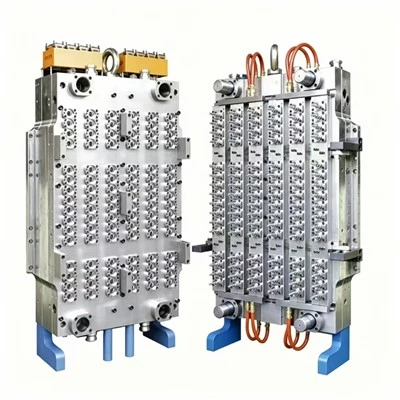
At the end of the day, a dropper cap mold isn’t just a metal block with holes. It’s the tool that turns your product’s vision into a functional, reliable cap that customers trust. It’s the thing that makes sure every drop is where it’s supposed to be, no mess, no hassle. If that sounds like what you need, let’s connect and talk through your project—whatever size, whatever custom features you need, we can build the right mold for you.
Blow Molding Mold References
- Rosato, D. V., & Rosato, M. G. (2000). Injection Molding Handbook. Van Nostrand Reinhold.
- European Plastic Converters Association. (2022). Precision Molding for Medical and Packaging Applications.
- American Society of Mechanical Engineers. (2019). Tolerancing for Injection Molded Plastic Parts.
- National Association of Container Distributors. (2021). Trends in Small-Liquid Packaging and Closure Design.
- Tooling & Molding Association. (2023). Best Practices for Dropper Cap Mold Design and Maintenance.
Taizhou Leizhen Mold Co., Ltd.
Taizhou Leizhen Mold Co., Ltd. is one of the most professional cap mold manufacturers and suppliers in China, also supports customized service with low price. Please feel free to buy CE approved cap mold made in China here from our factory. Contact us for pricelist.
Address: No.8828, Changtang Industrial Zone, Beicheng Street, Huangyan District, Taizhou City, Zhejiang Province
E-mail: ningleizhen@gmail.com
WebSite: https://www.leizhenmold.com/
