Hey there, Progressive Dies
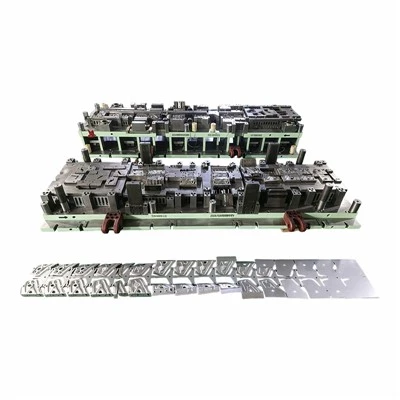
If you’re deep in the stamping game and work with progressive dies, you already know fine blanking is a whole different beast. It’s not your run-of-the-mill stamped part—those ultra-clean, burr-free edges, tight tolerances (we’re talking thousandths of an inch here), and consistent part quality don’t happen by accident. And as someone who’s been supplying progressive dies for 12 years now, the #1 thing that makes or breaks a fine blanking die job? The raw materials you feed into it. Not just any steel or metal will cut it—if you skimp here, you’re looking at die wear, scrap parts, and downtime that makes your whole production line grind to a halt. Let’s break down what I’ve learned over the years about the raw material requirements for fine blanking progressive dies, straight from the trenches.
First off, let’s make sure we’re on the same page: fine blanking progressive dies combine fine blanking (which uses triple counter pressure to get that perfect edge) with progressive stamping (multiple stations doing different operations in one pass). So the raw material has to play nice with both high-pressure fine blanking forces and the repeated bending, piercing, and forming of progressive stamping. It’s not just about strength—it’s about ductility, surface condition, consistency, and even how it interacts with the die lubricant. I’ve seen guys grab a cheap steel coil from a random supplier to save a buck, only to have the die break a punch or get a crack in the V-ring (that’s the key part for fine blanking pressure) within a week. Waste of money, full stop.
Let’s start with the big one: material grade selection. This isn’t one-size-fits-all. What works for a 1mm thick automotive seat bracket is way different from what you need for a 0.2mm thin electronic connector. Most fine blanking jobs use carbon steels, low-alloy steels, stainless steels, or sometimes non-ferrous metals like aluminum or copper for specialty parts. But here’s the catch: not all grades are fine blanking-approved. For example, plain carbon steels like SAE 1010 or 1015 are great for low-strength parts, but if you need higher tensile strength for a gear or a suspension component, you’ll want a low-alloy steel like SAE 4130 or fine blanking-specific grades like DC04F or DC06F. Wait, why the F? That’s the fine blanking designation—those grades are refined to have uniform grain structure, which is non-negotiable for a clean blank. I once had a customer bring in a batch of SAE 1020 that wasn’t a fine blanking grade, and the edges of their parts were all rough with micro-burrs. We had to adjust the die’s V-ring pressure three times before we got it right, and even then, the die wear spiked because the grain size was inconsistent. Grain size is a big sub-point here—needs to be fine and uniform, usually around 5-7 ASTM, so the metal shears cleanly instead of tearing.
Next up, material thickness tolerance. This is non-negotiable, like, no exceptions. Progressive dies are built to a specific gap between the punch and die for a exact material thickness. If your coil varies by even 0.02mm, that gap is off, and you’re either crushing the material (leading to cracks in the die or the part) or leaving gaps (causing burrs and scrap). I’ve had a supplier send a batch of 0.8mm aluminum that was off by ±0.05mm—we ran 10 parts and had to stop because half had edges that were too sharp or too rough. For fine blanking, the thickness tolerance should be ±0.01mm max, especially for critical parts. Some applications, like medical components, need even tighter, ±0.005mm. Don’t take a supplier’s word for it—ask for a material test report (MTR) that confirms thickness consistency along the entire coil length, not just the first few feet. I keep a copy of every MTR for every job my dies run, so if something goes wrong, I can check if it was material or die setup.
Surface condition is another make-or-break factor. If the raw material has scratches, pits, oil residue, or a uneven surface, that translates straight to the part and the die. Wait, how does it affect the die? Let’s think: in fine blanking, you have that triple counter pressure holding the material tight to the die surface. If there’s a pit in the material, the pressure can’t distribute evenly, which puts extra stress on the punch and V-ring, leading to early wear or failure. Also, surface contamination—like residual lubricant from the mill that’s not properly cleaned—can mess with the die lubricant you use in production, causing galling (that’s when material sticks to the die surface) which ruins parts and requires die maintenance way more often. I always tell customers to ask for raw material with a surface finish of Ra ≤ 1.6 μm, and make sure it’s free of any mill scale, deep scratches, or foreign particles. Once, a customer ran a batch of stainless steel with mill scale and had 20% scrap parts because the scale left a rough spot on the blank edge. We had to send their die back for a polish and they had to reorder material—cost them thousands in downtime. Lesson learned: surface condition isn’t just about the part looking good; it’s about die life and yield.
Ductility vs. strength balance—this is the sweet spot you have to nail. Fine blanking requires the material to deform slightly under high pressure without cracking, so ductility is key. But if it’s too ductile, it’s going to tear or stretch instead of shearing cleanly. For most fine blanking jobs, the elongation at break should be at least 15% for carbon steels, 20% for low-alloy steels, and higher for non-ferrous metals. Tensile strength is usually in the range of 300-800 MPa for standard applications, but again, depends on the part. Wait, what if you need a stronger part, like for a structural component? You can’t just grab a high-strength steel—it might be too brittle. Some suppliers offer “fine blanking-ready” high-strength low-alloy (HSLA) steels that are processed to have the right ductility without losing strength. I had a job a while back for a automotive transmission bracket that needed a 500 MPa tensile strength and clean edges. A standard HSLA steel tore in the fine blanking stage, but switching to a fine blanking-specific HSLA fixed it—no more tears, part edges were perfect, and the die didn’t wear any faster than normal. Another thing: anisotropy. That’s when the material’s properties (ductility, strength) change depending on the direction you stamp it. Most raw materials have some anisotropy, but for fine blanking, you need it to be as low as possible. That means the grain flow in the material is aligned properly so when you form or pierce it, it doesn’t crack along the grain lines. I always check the anisotropy value in the MTR—aim for less than 10% difference in ductility between rolling direction and transverse direction.
Material cleanliness and inclusion level—this is one that’s easy to overlook but can ruin a die. Inclusions are tiny particles (like oxides, sulfides, or silicates) trapped in the metal during manufacturing. These particles are harder than the base material, so they act like little abrasives that wear down the punch, die, and V-ring over time. For fine blanking, inclusion levels need to be low—usually class 2 or lower per ISO 4967 standards. I once had a customer use a cheap steel coil with class 5 inclusions, and their die punches wore out twice as fast as normal. They thought it was a die material issue, but when we tested the raw material, the inclusions were chipping away at the punch surface. Switching to a cleaner steel (class 1 inclusions) tripled the punch life. Also, hydrogen content—wait, that’s for high-strength steels. If you have a high-strength fine blanking steel with too much hydrogen, it can cause delayed cracking in the part or even the die. Always check the hydrogen content for grades over 800 MPa tensile strength—should be less than 2 ppm.
Coil handling and dimension consistency beyond thickness—wait, things like coil width, flatness, and edge condition. If the coil is too narrow or too wide for your die, you’re going to have alignment issues in the progressive die, which leads to parts being off or scrap. Also, if the coil is wavy (flatness error), when you feed it into the die, it can bounce or shift, causing misalignment in stations. For progressive dies, the coil should have flatness of ≤ 0.5 mm per meter, and the edges should be clean, no burrs on the coil itself. Coil edge burrs can scratch the die entry guide and cause material to feed unevenly. I always advise customers to specify that the raw material has slitted edges with a max edge burr of 0.01mm. I’ve had a job where a supplier’s coil edge had a 0.03mm burr, and the die’s entry guide got scratched, leading to 15 parts being scrapped before we caught it. It’s the small stuff, but it adds up.
Now, let’s talk about specialty cases, because fine blanking isn’t just for automotive brackets. If you’re running thin materials, like electronic connectors at 0.1-0.5mm thick, you need super thin, consistent material. For copper or brass, ductility is even more critical—those materials are soft, so if there’s any inconsistency, they tear easily. Also, for stainless steels, galling is a big issue, so you might need a material with a lubricated surface (like a thin layer of phosphate or oil) that’s compatible with fine blanking. I worked on a medical device job a few months back, tiny 316L stainless steel stents, 0.2mm thick. We had to use a fine blanking-grade 316L with tight thickness tolerance, low inclusions, and a light phosphate coating to prevent galling. The part requirements were edge roughness ≤ 0.8 μm, and we hit that every time because the material was spot-on.
Wait, let’s circle back to what this means for you, the person buying progressive dies or sourcing raw material. I’ve seen too many shops cut corners on raw material to save a quick buck, and it almost always costs more in the long run—die replacements, downtime, scrap, rework. Here’s my go-to checklist for raw materials in fine blanking progressive dies:
- Grade: Fine blanking-approved (check for designations like F, FB, or fine blanking-specific grades from reputable mills, not generic carbon steel).
- Thickness tolerance: ±0.01mm or tighter, confirmed via MTR.
- Surface: Ra ≤ 1.6 μm, no mill scale, scratches, or contamination.
- Ductility: Elongation ≥15% for carbon, ≥20% for alloys, anisotropy <10%.
- Cleanliness: Inclusions ≤ ISO 4967 Class 2, hydrogen content <2ppm for high-strength grades.
- Coil specs: Flatness ≤0.5mm/m, width matching die requirements, edges with ≤0.01mm burr.
And let’s not forget working with a reputable raw material supplier—someone who can provide you with the MTR you need, not just a piece of paper that says “good steel.” I’ve partnered with mills that specialize in fine blanking raw materials for over a decade, and that consistency is what lets me build dies that run for thousands of parts without issues. If you’re not sure if a material is right for your job, send me the details: part thickness, material grade, application, and I can walk you through what to ask your supplier.
Look, at the end of the day, fine blanking progressive dies are precision tools that demand precision inputs. The die’s design and material matter, sure, but the raw material is the foundation. I’ve built dies that run 500,000 parts with no major issues, and others that had to be reworked because the raw material was off. The difference? Sticking to the requirements, not cutting corners.
If you’re in the market for a new progressive die, or you’re dealing with frequent scrap or die wear that you can’t figure out, hit me up. I’ve helped dozens of guys diagnose material issues that were causing their production headaches, and I’d be happy to chat through your specific needs. No sales pitch, just real advice from someone who’s been in this game long enough to know what works.
Metal Stamping Dies References
- ISO 4967: Steel – Determination of non-metallic inclusion content – Microscopic method for classification
- Smith, D. (2021). Fine Blanking: Principles, Materials, and Applications. Industrial Press Inc.
- ASTM A1008/A1008M: Standard Specification for Steel, Sheet, Cold-Rolled, Carbon, Structural, High-Strength Low-Alloy, and High-Strength Low-Alloy with Improved Formability
Dongguan Changdong Tool & Die Co., Ltd.
With abundant experience, we are one of the most reliable progressive dies manufacturers and suppliers in China. Please feel free to buy advanced progressive dies made in China here from our factory. Good service and quality products are available.
Address: No. 56-B, Fumin South Road, Dalang Town, Dongguan City, Guangdong Province, China
E-mail: sales@stamping-die.com
WebSite: https://www.metalstampingdie.com/
